


Bloody Sunday campaigner John Kelly changed the history of his own city through his successful battle to establish the innocence of those killed in the British Army shootings, his funeral has heard.
Mr Kelly’s 17-year-old brother Michael was one of 13 people shot dead on January 30 1972 when members of the Parachute Regiment opened fire on civil rights demonstrators in the Bogside area of Londonderry.
The former chairman of the Bloody Sunday Trust, who died on Saturday, spent decades campaigning for justice for his brother and all the others who died or were injured in Derry on that day.

That campaign had its high point at the publication of the landmark Saville report in 2010 and the subsequent UK government apology for the events of Bloody Sunday delivered by then prime minister David Cameron.
Lord Saville found there was no justification for shooting any of those killed or wounded in a report that overturned the long-disputed findings of the 1972 Widgery Tribunal, which had concluded that the soldiers had been shot at first, and returned fire in self-defence.
Issuing a public apology in the House of Commons, Mr Cameron described the killings as “unjustified and unjustifiable”.
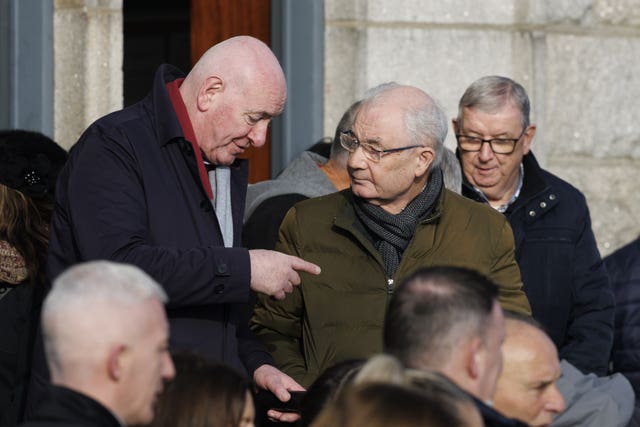
Paying tribute to his friend at the start of Monday’s funeral service at St Mary’s Church in Creggan in Derry, Tony Doherty, the current chairman of the Bloody Sunday Trust, described him as a gentleman who was never afraid to say what needed to be said.
“If it had to be said, it was usually John that was the one who would say it,” he told mourners in his eulogy.
“John was deeply affected by the murder of his young brother Michael.
“He got a strength which carried him through the darkest of times from the realisation that he now spoke for Michael, the innocent teenager who fell dead in Rossville Street, and, in speaking for Michael and by declaring his brother’s innocence, often challenged, he wasn’t going to be cowed down by anyone, friend or foe.”
Mr Doherty said Mr Kelly took great pride in his work at the Museum of Free Derry in the Bogside.
“Because British armed forces murdered so many innocent people and told lies about their deaths, many of us northerners have had to spend huge chunks of our lives struggling to achieve truth and justice, out of a system which was culturally tone deaf to those basic concepts,” he said.
“The working-class man from Dunmore Gardens in Creggan became the leader of our campaign for truth and justice at a time when leadership was badly needed.
“From humble, uncertain and unsteady beginnings in 1992, he guided, encouraged, nurtured, and lit the pathway of what was to become an epic battle for our human rights against all the odds.
“So, what did this boy from Creggan achieve? He led one of the most successful family campaigns ever to have impacted on these islands.”
Mr Doherty said the campaign had become the benchmark for other families pursuing justice.
“He was largely responsible for bringing about the second inquiry into the murders in Bloody Sunday, which established the innocence of all the dead and wounded,” he said.
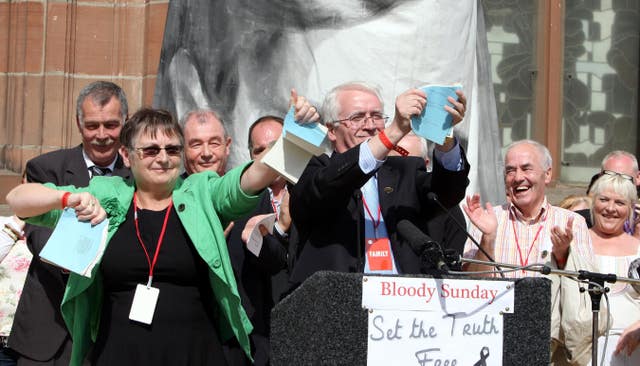
“He forced the British prime minister to apologise for the murders and mayhem on the streets of Derry on Bloody Sunday, and along with Jean Hegarty (whose 17-year-old brother Kevin McElhinney was killed) literally tore the despised Widgery report into shreds on the steps of the Guildhall (in Derry).
“Put simply, he changed the city. He changed the history of this city.”
Mr Doherty added: “When we are all dead and gone, future generations of scholars will write the true history of the city of Derry and how we forced the British to admit their terrible deeds. John’s name will be writ brave and bold into that history, brave and bold – for that’s what he was.”
In his homily, parish priest at St Mary’s Fr Daniel McFaul said Mr Kelly was a man who fought the good fight, finished the race and kept his faith.
“John and the Kelly family, like so many families in our city, were dealt a very difficult hand on Bloody Sunday in 1972,” he told Mr Kelly’s six sons.
“He and his family suffered the injustice of his brother being cruelly taken from him and, through the suffering and trauma he and his family experienced, he found a reason to seek justice for his brother Michael, for those killed on Bloody Sunday, and for their families.
“Through John’s determination, his courage, and his perseverance, he helped ensure that the voices of those killed and their families would be heard.
“And also what drove him was the love that he had, yes, for his brother Michael, for his grieving parents, but also for you, his six sons.
“He had a desire to make our city a better place for you, his children and grandchildren’s generation. He and your mammy (the late Margaret) fought hard to bring justice and peace to future generations in our city, and they finished the race.”
Fr McFaul described Mr Kelly as the “rock” of his family.
“Every one of us, we’re given a race to run in this life,” he said.
“We don’t choose all the circumstances of that race. We don’t choose the suffering that comes our way, the crosses we’re asked to carry or the losses that we must endure, but we do choose how to respond.
“And John Kelly responded with determination. He carried the memory of his brother Michael and the pain of his parents’ grief at Michael’s death. He carried the hopes of his family, and he carried a responsibility that few people would ever have to shoulder.
“Your daddy’s greatest legacy is not simply what he achieved in public life, but the love that he leaves behind in each one of you, because, in the end, the measure of a man’s life is not simply the recognition he receives or the causes he champions, important as they are. It’s also found in the people he has loved, the faith and values he has passed on, along with the witness and example he has given, and of course, the memories he leaves in the hearts of you, his family and friends.”
Addressing Mr Kelly’s grandchildren, the priest added: “Your granddad was a part of an extraordinary chapter in the history of our city, and he was your granda.
“As you grow older, you will hear people speak about his courage, his determination, his loyalty, and his commitment to justice. You will show your friends around the museum that he helped create, and you will continue to tell his story. Be proud of that.”
In conclusion , Fr McFaul said: “One final thought: you will hear many tributes to your daddy and your granddad. People will speak about the public man, the campaigner, the man who refused to give up, and rightly so. We are indebted to him in our city. The world knew him as John Kelly from Bloody Sunday.
“You loved him as your daddy and your granddad. Carry that love with you. Carry his memory with pride and, above all, carry forward the best of what he stood for: truth, justice, courage, perseverance, love, faith, and the dignity of every human person.”
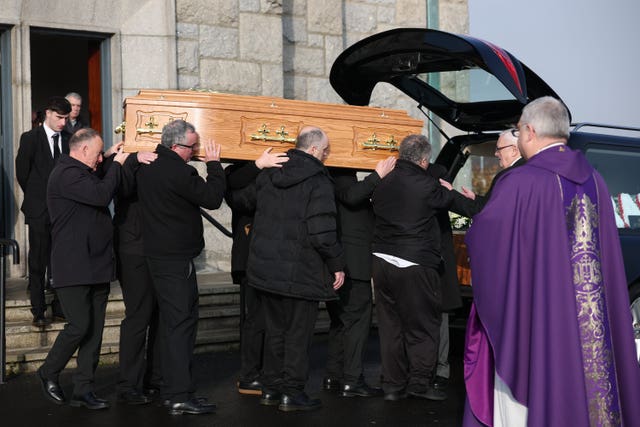
After the service, Mr Kelly’s remains were taken to the nearby City Cemetery for burial.


Share